
High-rise elegance: Milan's Pirelli Tower
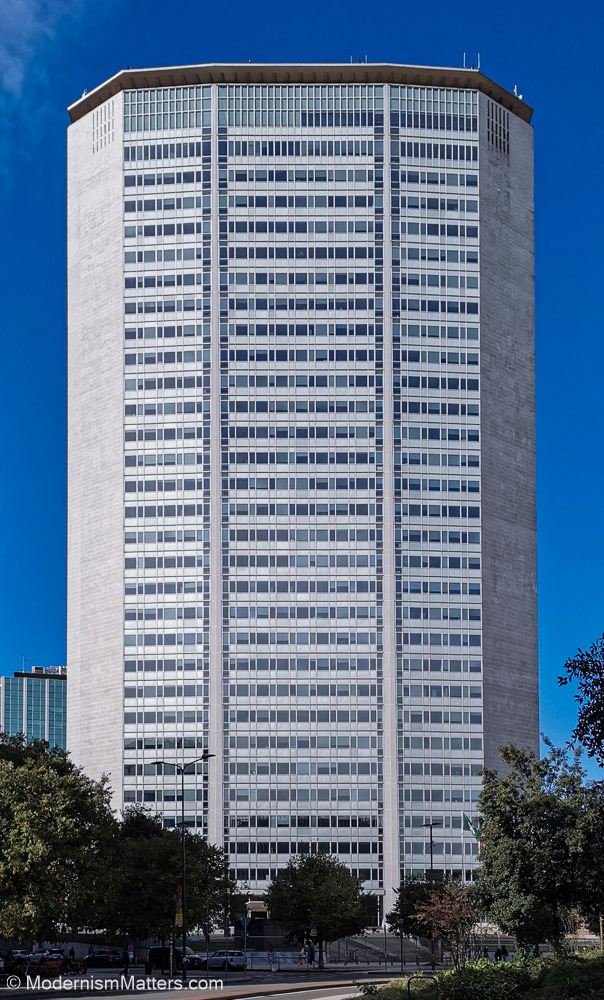
The Pirelli Tower (1956-1958) in Milan, Italy – designed by a team of architects led by Milan native Gio Ponti, in collaboration with the renowned Italian structural engineer Pier Luigi Nervi – was among the first modern skyscrapers constructed in Europe.
In a city that isn’t short of iconic landmarks (the elaborate Duomo and Galleria Vittorio Emanuele II being amongst the most prominent), the Pirelli Tower has become an instantly recognisable symbol of Milan’s skyline: so much so that a silhouette of the building featured on promotional merchandise for the Milan Expo in 2015.
As Ponti’s monographer Graziella Roccella (1) details, the Tower was envisioned by Pirelli’s management, in the mould of American corporate high-rises, as a headquarters building that would serve as a visible manifestation of the company and its prestige. Its relative loftiness at 127 metres – modest by current standards, though it remained Italy’s tallest building for more than three decades until surpassed by Naples’ marginally taller Telecom Italia Tower in 1994 – was alone enough of an architectural statement in a predominantly low-rise city. Yet, it was also the building’s sleekly modern glass and aluminium-clad facade and svelte proportions that helped it stand out. Although measuring 75 metres as its widest point, the Pirelli Tower has a depth (front to back) of just 20 metres, giving the building an “astonishingly slender”(2) profile that accentuates its verticality (see photo below). This slenderness derives from the Pirelli Tower’s idiosyncratic, elongated octagonal form (when seen from above), which clearly distinguished it from the derivative cuboid-shaped corporate skyscrapers that proliferated in American cities in the 1950s and beyond in the wake of seminal buildings such as Skidmore, Owings & Merrill’s Lever House in New York City (completed in 1952). The expansive Piazza Duca d’Aosta fronting the Pirelli Tower also adds a sense of openness to the local area, serving to further exaggerate the building’s physical stature.
An additional contrast to conventional American skyscraper design is seen in the Pirelli Tower’s innovative structure. Whereas steel frames predominated in US high-rises, the Pirelli Tower utilised an innovative reinforced concrete frame.
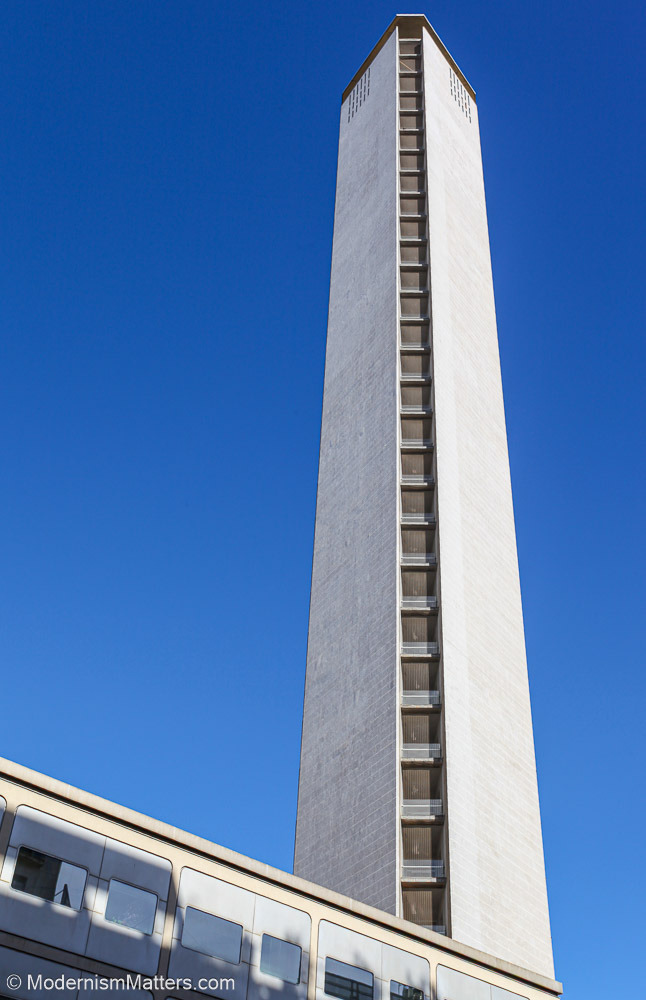
As architectural historian Judith Dupre (3) outlines, the ability to construct a tall building with a narrow footprint drew heavily on Nervi’s engineering expertise. To achieve sufficient structural integrity whilst minimising load bearing, Nervi incorporated two pairs of concrete pillars – clearly visible on the Tower’s main elevations – that narrow as the building rises upwards. The building is further braced, as Dupre notes, by pairs of triangular concrete supports book-ending the Tower, giving it its distinctive angled edges.
The Pirelli Tower’s striking, slender form has garnered the building much praise, including from architect and author Hasan-Uddin Khan, who called it "one of the most elegant tall buildings in the world"(4). The characteristic shape of the Pirelli Tower has also been acknowledged as a source of inspiration for Walter Gropius’s MetLife Building (5) – formerly the Pan Am Building (completed in 1963) – which towers over Grand Central Station in New York City.
Whilst the genesis of the Pirelli Tower may have lain in transposing a conspicuously American building sentiment to post-war northern Italy, the Pirelli Tower’s radical yet elegant modernist aesthetic, innovative structural engineering, and ‘landmark status’ has ensured it a legacy far beyond that of any mere architectural facsimile. Today, more than sixty years after its completion, and despite a long-term change of use (the building has been home to the Lombardy regional government since 1978), the Pirelli Tower endures as a prominent feature of the Milan skyline and a touchstone of 1950s Italian design and ingenuity.
_______________________________
Notes:
(1) Roccella, G. (2009). Gio Ponti: Master of Lightness. Cologne: Taschen.
(2) Dupre, J. (1996). Skyscrapers. New York: Black Dog & Leventhal, p. 53.
(3) Ibid.
(4) Kahn, H-U. (1998). International Style: Modernist Architecture from 1925 to 1965. Cologne: Taschen, p.147.
(5) Powers, A. (2019). Bauhaus Goes West: Modern Art and Design in Britain and America. London: Thames & Hudson.
Copyright ©2026 ModernismMatters.com. All Rights Reserved.