Architecture on stage: Birmingham’s Repertory Theatre
The Birmingham Repertory Theatre, commonly known as ‘The Rep’, is home to one of the most prestigious theatre companies in the UK. A recipient of a Royal Institute of British Architects (RIBA) award a year after its opening in 1971, the building remains a beacon of Birmingham’s extensive post-war redevelopment programme.
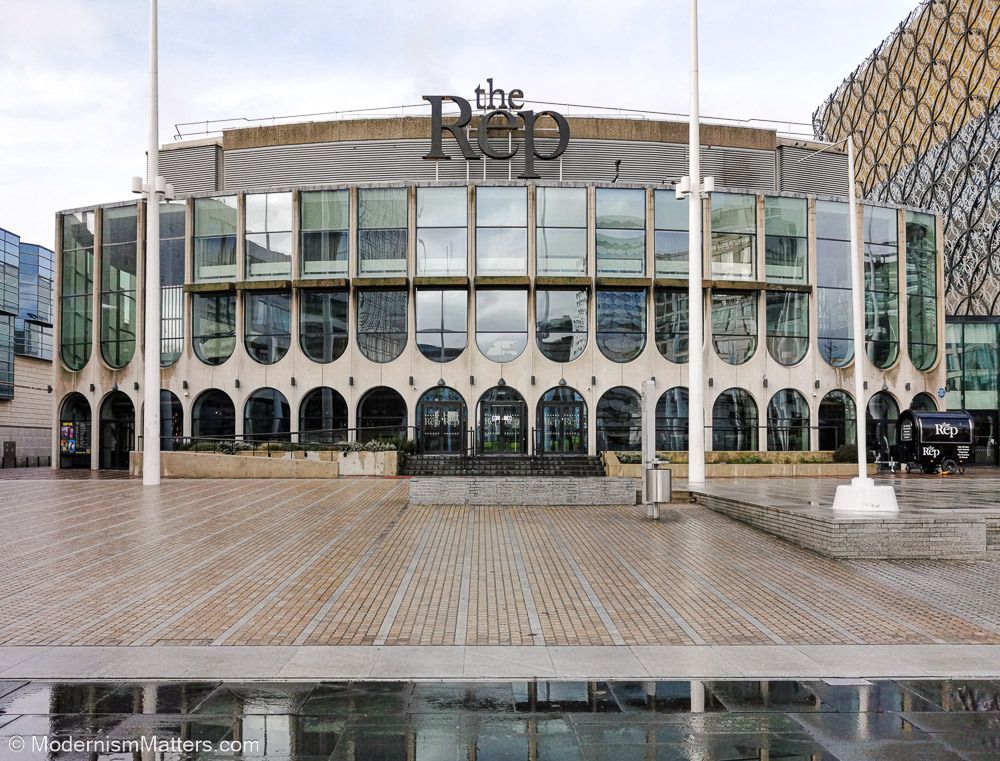
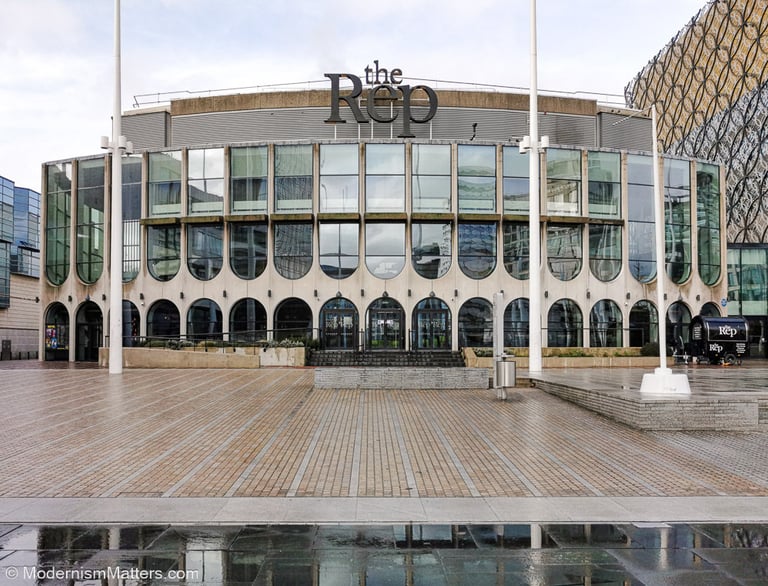
Designed by Graham Winteringham – whose earlier work included Birmingham’s former Crescent Theatre – The Rep is characterised by its bow-shaped concrete and glass main façade, and distinctive arrangement of repeated arch (and taller inverted arch) windows. Here the structure has the aesthetic lightness of so-called ‘Festival style’ architecture, a look which emerged from the Festival of Britain in 1951, with The Rep subtly evoking the gentle sweeping curve of the Royal Festival Hall’s river-facing frontage. There are also echoes of the towering, neoclassical-influenced arches of Wallace K. Harrison’s Metropolitan Opera House (1959-1966), the iconic centrepiece of the Lincoln Center in New York City. Yet The Rep’s elegant modernist façade is only part of its architectural make-up. Immediately behind its fan-shaped, 816-seat auditorium, the building comprises a Brutalist ensemble of chunky, interconnected concrete sections, the tallest of which, the fly tower, houses the main stage and set machinery (see photo below).
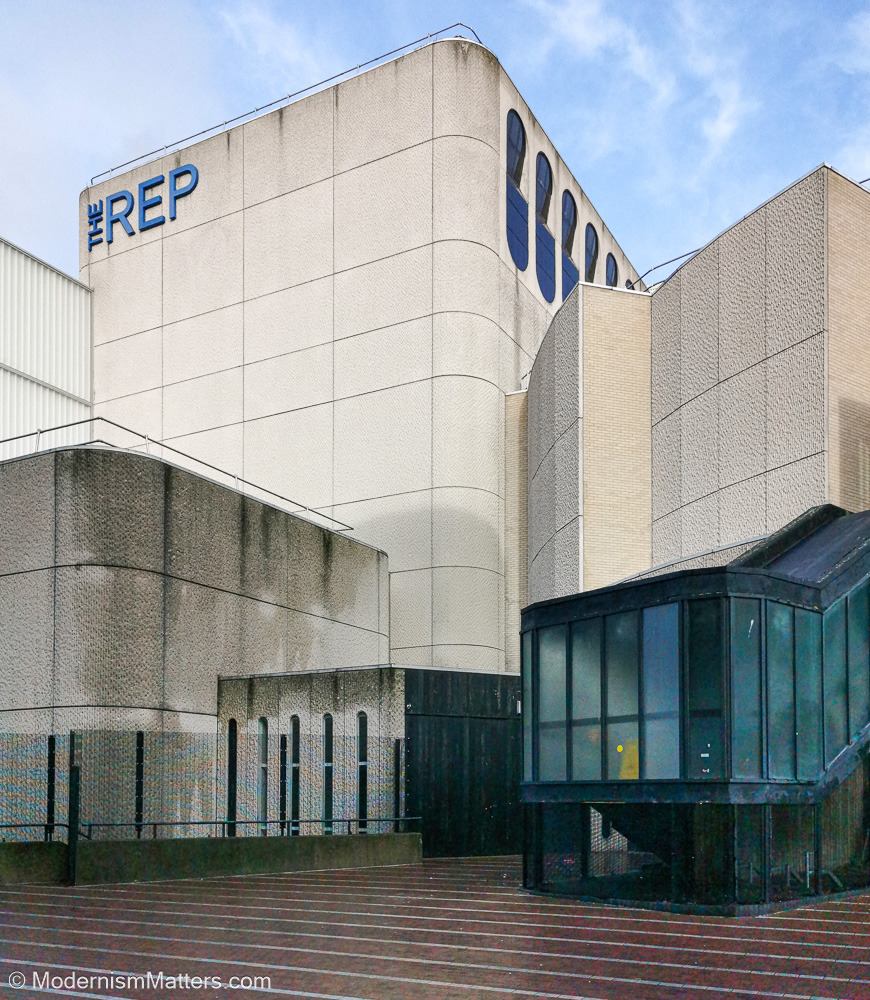
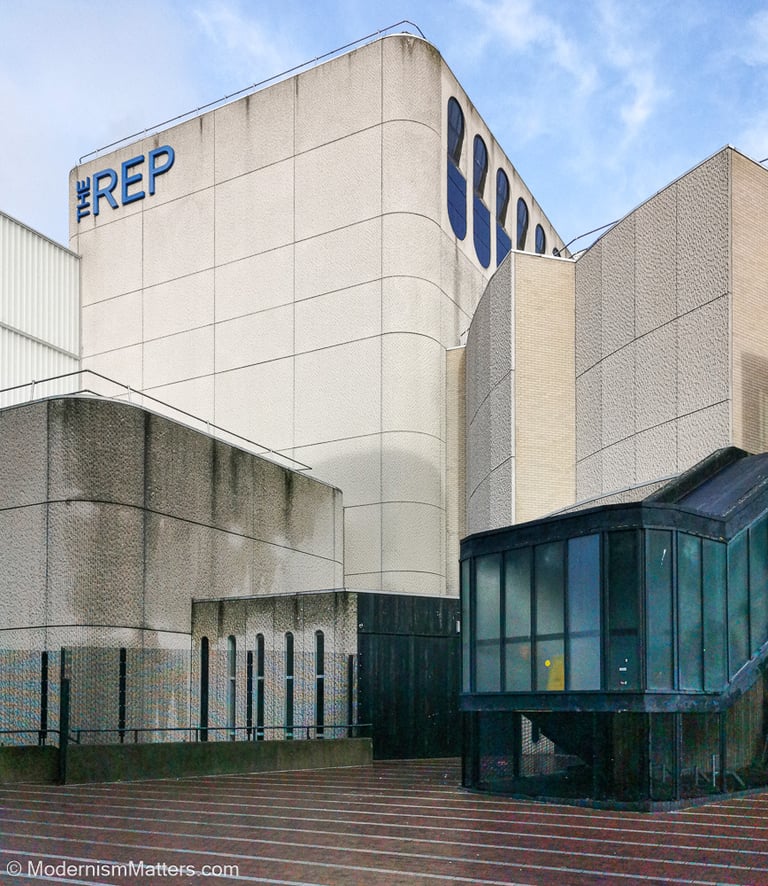
Two smaller playhouses – The Studio and The Door – occupy the lower-rise sections of the building, flanking either side of the fly tower. Newer extensions to the rear of the complex accommodate backstage facilities, rehearsal spaces and storage areas.
The Rep retains a distinctive presence in Birmingham’s Centenary Square, despite being hemmed between two much larger neighbouring buildings. Immediately to its west is the International Convention Centre (ICC) (1987-1991), a sprawling complex whose stone clad and blue glazed exterior gives way to a bright and airy mall-like interior, with exposed 'high-tech’ structural elements – including a criss-crossing network of blue tubular steel roof supports and elevated walkways. Connected to The Rep via a two-storey extension on the theatre’s east side is the hulking mass of Mecanoo Architects’ overtly spangly Library of Birmingham, opened in 2013. This served as a replacement for architect John Madin’s former Central Library (1969-1973), an ‘inverted ziggurat’ Brutalist landmark that stood nearby in Chamberlain Square until being demolished in 2016. Construction of the new library and its integration with The Rep required the remodelling of the latter, including removal of the theatre’s eastern annexe, an addition from the early nineties.
The Rep has witnessed much change over its lifetime, both in terms of alterations to the building itself and to the surrounding environment, but its modernist character has been largely preserved. It is an important building that represents Birmingham’s remarkable (though ever-dwindling) post-war architectural heritage – the Ringway Centre on Smallbrook Queensway being the latest of the city’s 1960s and 70s landmarks to be slated for demolition as part of ongoing urban regeneration activities. Also, 2025 saw the permanent closure of architect Sir Frederick Gibberd’s Priory Square shopping centre (1963-1966), originally known as Corporation Square, with the building now facing an uncertain future.
Copyright ©2026 ModernismMatters.com. All Rights Reserved.