
Trellick Tower: A concrete village in the sky
Trellick Tower is arguably the most famous and distinctive residential tower block in the UK, and an acknowledged masterpiece of Brutalist architecture.
Constructed over a four-year period, and opened in 1972, Trellick Tower is the defining work of the Hungarian-born architect, Ernő Goldfinger, who relocated to London in the mid-1930s. The 98-metre-tall, 31-storey tower forms the centrepiece of the Cheltenham Estate – a Greater London Council-commissioned social housing complex in Kensal Town, West London. The design of the tower was driven by Le Corbusier-esque utopian ideals, with Goldfinger envisioning a ‘vertical village’ of high-quality, naturally-lit and well-ventilated dual-aspect accommodation, complimented by ample communal space for residents, and neighbourhood amenities such as a shop and pub, at ground level. The architect even temporarily resided in Trellick’s 1967 predecessor, Balfron Tower, in East London, to gain first-hand experience of life as a resident and to gather views on the building’s design and functionality from other tenants, which he duly incorporated as refinements in his new project. However, despite Goldfinger’s noble aims, Trellick Tower was blighted by poor security and inadequate maintenance, and rapidly became a hotspot for crime and anti-social behaviour in the 1970s and 1980s, though it has since seen quite a reversal in its fortunes.
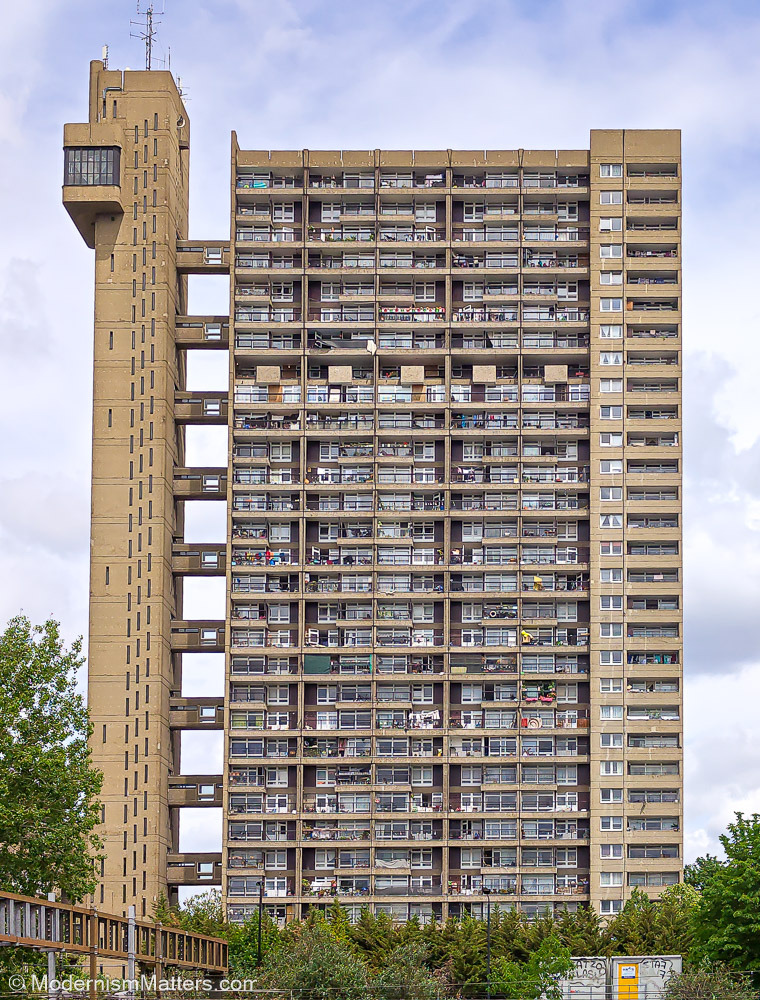
The tower stands, sentinel-like, on a slightly elevated plot at the northern end of bustling Golborne Road, looming over the adjacent Grand Union Canal. It is a Brutalist behemoth of exposed, bush-hammered concrete and sharp angularity that unapologetically lays bare its structural anatomy. On the South façade of the building, apartment balconies are arranged in a repeating sequence of tiered, full-length platforms spanning the main structure, interspersed with smaller double-bay deck sections, creating a dynamic geometric pattern that helps break up the building’s mass. Trellick’s defining architectural characteristic is its adjoining slim auxiliary tower, housing lift shafts, a stairwell and other services, which is connected to the accommodation block by a series of ten enclosed footbridges integrated at every third storey; visually, the effect resembles a vast, slab-like space rocket tethered to its launchpad gantry tower.
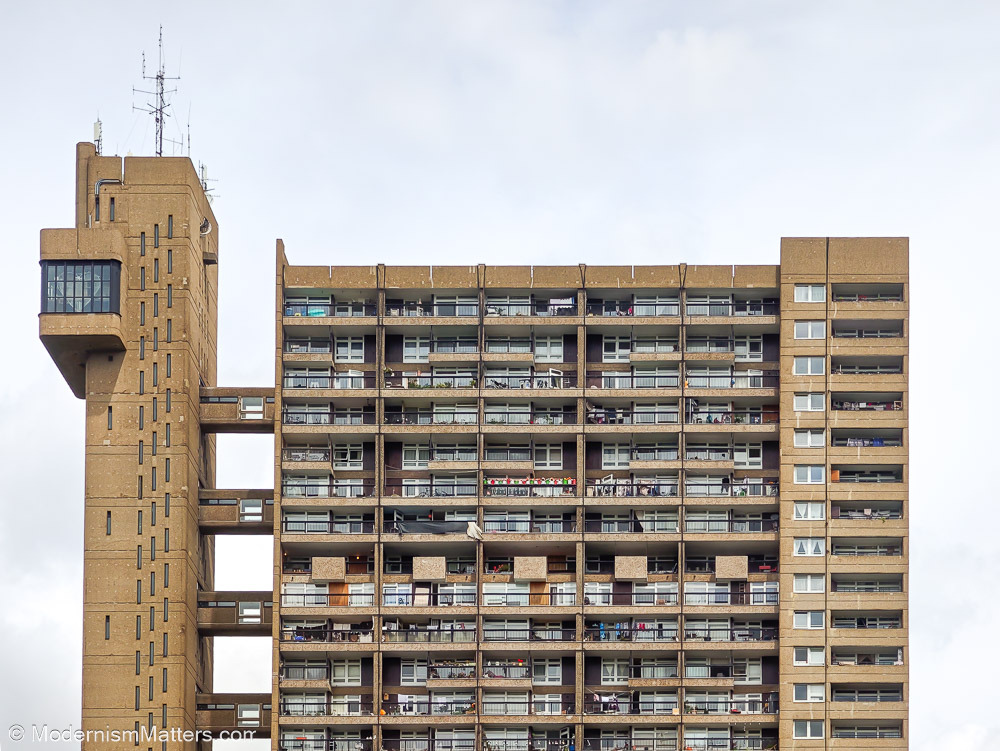
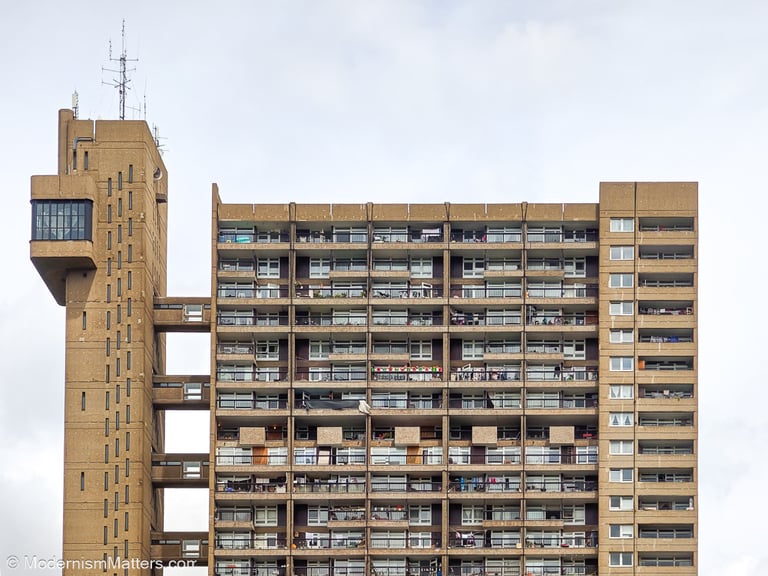
It affords the building a highly distinctive architectural silhouette, unmissable to anyone travelling along the Westway – the elevated arterial road that winds its way through West London – or those taking a train to/from Paddington station.
Trellick Tower's early struggles with neglect and crime were gradually overcome through resident-led activism in the mid-1980s, which saw the introduction of a concierge service and other improvements to security. Increased private ownership of apartments also encouraged greater investment in the building’s upkeep. A growing recognition of the tower’s architectural significance culminated in its Grade II* listing in 1998 – a very rare designation for a residential tower block, signifying a building of particular national importance – whilst the diffusion of urban revitalisation emanating from neighbouring Notting Hill from the 1990s onwards has only increased Trellick’s desirability. Over the last ten years, the full-on reappreciation of Brutalist architecture, as well as Trellick Tower’s Instagram-friendly aesthetic, has seen the building positioned as something of a poster child for the cause, with images of the tower adorning everything from mugs to tote bags. Though a building as bold and uncompromisingly concrete as Trellick Tower still won’t be to everyone’s taste, its rehabilitation as an architectural tour de force and pop culture emblem appears largely complete.
Copyright ©2026 ModernismMatters.com. All Rights Reserved.